
Website maintenance is the ongoing process of keeping a website secure, fast, functional, and up to date. Without a formal maintenance strategy, businesses risk security breaches, ranking drops, slow load times, and costly downtime. According to multiple 2024–2025 studies, 83% of hacked websites were running outdated software—a problem that proactive website maintenance services can almost entirely prevent.
Your website was not “done” the day it launched. That’s the single most important thing to understand before reading further.
Thousands of businesses make this exact mistake every year—investing heavily in design and development, then walking away. No updates. No monitoring. No plan. The result? A digital storefront that quietly deteriorates: loading slower each month, growing more vulnerable by the day, and gradually slipping down Google’s rankings without anyone noticing until it’s too late.
The data tells a stark story. According to Google (2024), 53% of mobile users abandon a site that takes longer than 3 seconds to load. Akamai research shows that even a 1-second delay in page speed reduces conversions by 7%. And Verizon’s 2025 Data Breach Investigations Report reveals that 43% of cyberattacks now target small businesses—most of them through vulnerabilities that a timely software update would have closed.
This is Part 1 of The Complete Website Maintenance Guide by Codewitty—a deep-dive series built for business owners, marketing managers, IT leads, startups, SMEs, and enterprises who want to build a smarter, more resilient online presence. In this installment, we cover the fundamentals: what website maintenance actually means, why it matters more than ever in 2026, and how to think about it strategically rather than reactively.
In this guide, you will discover:
- What website maintenance services actually include (and what most businesses overlook)
- The real cost of neglecting your website—in downtime, lost revenue, and SEO rankings
- The difference between preventive and reactive maintenance—and why one consistently outperforms the other
- A high-level introduction to the Codewitty Website Maintenance Framework™, the structured approach Codewitty uses with startups, SMEs, and enterprise clients across India
What Is Website Maintenance?
Website maintenance is the continuous, structured process of keeping a website healthy, secure, high-performing, and aligned with business goals. Think of it the way you would think about maintaining a physical office—regular cleaning, security checks, equipment servicing, and the occasional renovation to keep up with changing needs.
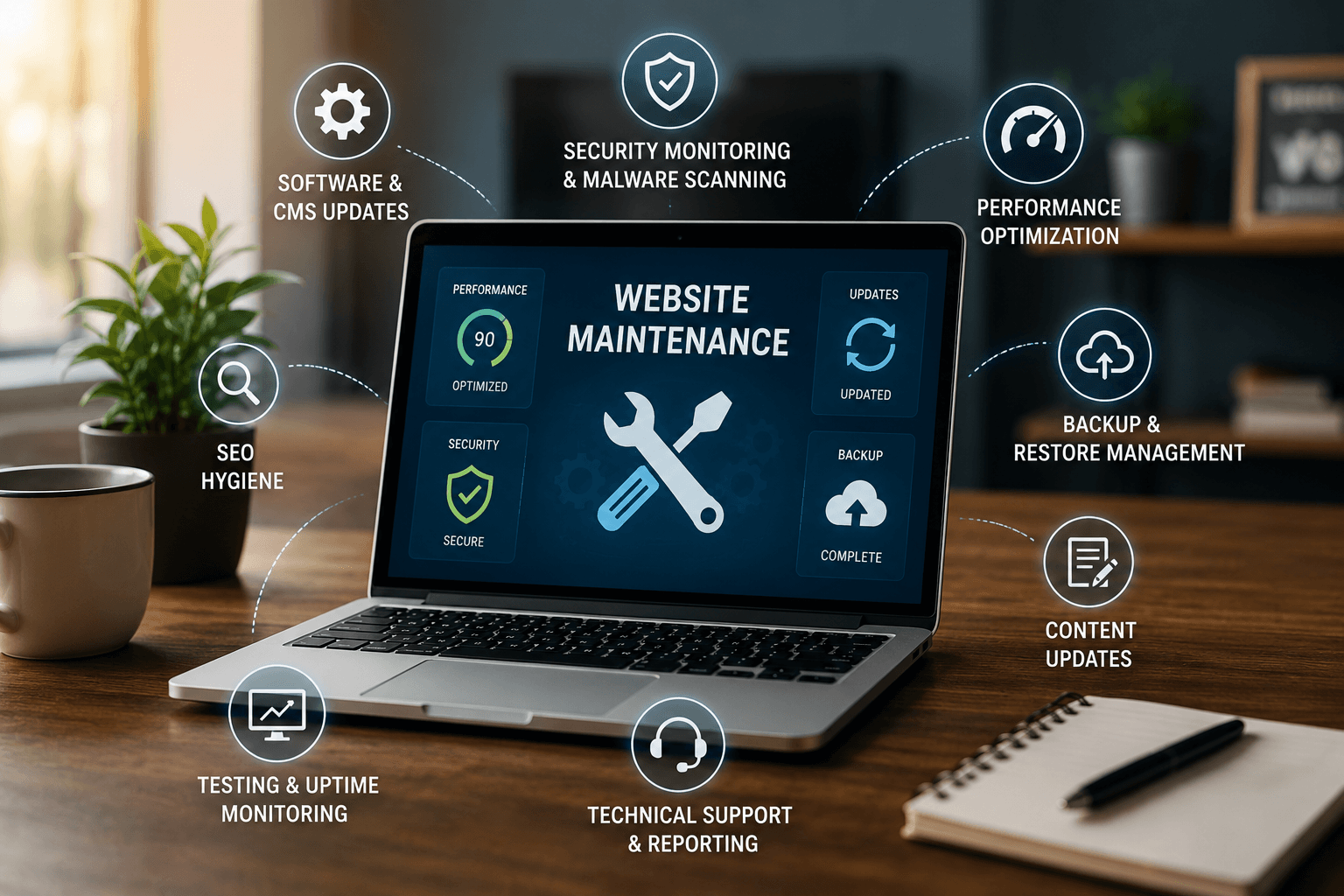
Effective website maintenance covers a broad range of activities:
- Software and CMS updates — keeping platforms like WordPress, Shopify, or Magento patched against known vulnerabilities
- Security monitoring and malware scanning — identifying and neutralizing threats before they cause damage
- Performance optimization — caching, image compression, and hosting management to maintain fast load times
- Backup and restore management — ensuring recovery is possible if something goes wrong
- Content updates — keeping pages, blogs, and product listings fresh and accurate
- SEO hygiene — fixing broken links, updating metadata, and monitoring Core Web Vitals
- Testing and uptime monitoring — catching errors before your users do
- Technical support and reporting — ongoing communication about your site’s health and progress
No two websites have identical maintenance needs. A Shopify e-commerce store serving thousands of daily transactions requires different care than a five-page corporate brochure site. That’s precisely why Codewitty’s website maintenance services are built around customized, flexible plans—monthly, hourly, or on-demand—tailored to the unique requirements of each client.
Why Website Maintenance Matters More Than Ever in 2026
Here is a truth that is easy to underestimate: the web does not stand still. Browser updates change how sites render. Search engine algorithms evolve, and sites that were well-optimized two years ago may no longer qualify today. Security vulnerabilities emerge in plugins and CMS frameworks weekly. User expectations for speed and usability keep rising.
A business that treats its website as a static asset—built once, left alone—is effectively falling behind every single day.
The numbers confirm this urgency. 88% of online consumers say they are less likely to return to a website after a poor experience (Usability Geek). 75% of users never scroll past the first page of Google results (IT-Premium, citing Moz data). And Google’s mobile-first indexing policy means that if your mobile experience is slow or broken, your entire site’s ranking suffers—regardless of how well the desktop version performs.
For businesses operating in competitive markets, the margin for error is thin. A website that loads slowly, displays errors, or triggers browser security warnings does not just lose visitors—it loses them to competitors who have invested in proper website management and support.
Understanding the Website Lifecycle
Every website moves through a predictable lifecycle, and understanding it is the foundation of any intelligent maintenance strategy.
Phase 1 — Planning & Strategy: Defining goals, audience, architecture, and technology stack.
Phase 2 — Design & Development: Building the visual identity and functional infrastructure.
Phase 3 — Launch: Going live and making the site publicly accessible.
Phase 4 — Growth & Optimization: Post-launch SEO, performance tuning, and content expansion.
Phase 5 — Ongoing Maintenance: The longest and most business-critical phase—continuous monitoring, updating, securing, and improving the site to keep it competitive.
Phase 6 — Redevelopment or Retirement: When the platform or design is no longer viable and a rebuild is required.
Most businesses invest heavily in Phases 1–3 and neglect Phase 5 entirely. The reality is that Phase 5 is where the return on the original investment is either protected or eroded. A well-maintained website continues to generate leads, rank well, and convert visitors for years. A neglected one starts declining almost immediately after launch.
Preventive vs. Reactive Website Maintenance: What's the Difference?
This distinction deserves more attention than it typically gets. Most businesses operate in reactive mode—they fix problems after they occur. A reactive approach feels cheaper in the short term. It rarely is.
When we place these two approaches side by side, the gap in outcomes becomes difficult to ignore:
Factor | Preventive Maintenance | Reactive Maintenance |
Cost over time | Predictable, lower monthly cost | Unpredictable, high spike costs when crises hit |
Downtime risk | Minimal—issues caught before impact | High—problems discovered after damage is done |
Security posture | Strong—regular patches and scans | Weak—vulnerabilities left open until exploited |
SEO impact | Stable or improving rankings | Risk of ranking drops from broken pages, slow speeds |
User experience | Consistent, fast, error-free | Degraded during incident periods |
Recovery costs | Near zero | $3,000–$25,000+ for a hacked site (IT-Premium, 2026) |
Business continuity | High—backups tested regularly | Uncertain—backups may not exist or may fail |
Verdict | Long-term winner | A false economy |
The logic here is simple, but many businesses don’t act on it until something breaks. Preventive website maintenance services eliminate the vast majority of incidents that reactive maintenance scrambles to resolve. The 80% figure from Uptime Institute’s 2025 Annual Outage Analysis says it plainly: 80% of operators believe better management processes would have prevented their most recent significant downtime event.

The Business Risks of Neglecting Website Maintenance
Neglect is not passive—it actively creates risk. Here are the four core categories of damage a poorly maintained website inflicts on a business:
1. Security Vulnerabilities and Data Breaches
This is the most acute risk. 30,000 websites are hacked every day globally (Sophos). 83% of compromised sites were running outdated software with known, patchable vulnerabilities (Sucuri). For WordPress users specifically, 39% of hacked sites were running an outdated CMS version at the time of the breach.
The financial aftermath is severe. Recovering a hacked website costs an average of $3,000 to $25,000, depending on complexity—before factoring in the reputational damage, the SEO penalty from being blacklisted by Google, and potential regulatory consequences for data exposure. According to the Ponemon Institute’s 2024 Cost of a Data Breach Report, the average global breach now costs $4.88 million—a 10% increase from 2023.
2. Performance Degradation and Lost Conversions
Websites slow down over time without optimization. Databases accumulate bloat. Plugins add weight. Images go uncompressed. The impact on revenue is direct and measurable: a 1-second delay in page load time reduces conversions by 7% (Akamai). Amazon’s internal data shows that every 100ms of additional latency costs the company 1% in sales—and that’s at massive scale, where the principle amplifies rather than diminishes for businesses closer to their margins.
3. SEO Ranking Drops
Search engines interpret poor technical health as poor quality. Slow page speeds, broken links, expired SSL certificates, and unoptimized Core Web Vitals all negatively affect rankings. HTTPS-secured sites rank 5–10% higher than non-HTTPS equivalents (Moz). Google officially made Core Web Vitals a ranking factor in 2021, meaning site speed and stability now directly influence search visibility.
4. Damaged User Trust and Brand Credibility
A “Not Secure” browser warning, a broken checkout page, or a site that crashes during peak traffic doesn’t just cost a single sale—it shapes how customers perceive the brand. 88% of online consumers say they are unlikely to return to a website after a poor experience. Trust, once lost, is expensive to rebuild.
What Does Website Downtime Actually Cost in 2026?
Downtime deserves its own section, because the numbers are extraordinary—and because many businesses dramatically underestimate the exposure.
According to Splunk’s 2024 “Hidden Costs of Downtime” report (conducted with Oxford Economics across 2,000 Global 2000 executives in 53 countries), Global 2000 companies lose $400 billion annually to downtime—representing 9% of their total profits. The average cost of a single minute of downtime has escalated to $14,056 for all organizations and $23,750 for large enterprises, a 150% increase from 2014 figures.
For smaller businesses, the proportional impact can be just as severe, if not worse. When we place industry-level data side by side, the scale of exposure becomes undeniable:
Business Type / Industry | Estimated Downtime Cost | Expert Verdict |
Large enterprises (general) | $23,750 per minute | Existential risk without resilience investment |
E-commerce (Global 2000) | $287 million annually | 43.5% above the cross-industry average |
Financial services (large institutions) | $12,000–$9.3M per hour | Regulatory consequences amplify direct costs |
Healthcare (medium hospitals) | $1.7 million per hour | Patient safety adds non-financial stakes |
SMEs and startups | Varies; even 1 hour is costly | Disproportionate impact on lean operations |
98% of all organizations | $100,000+ per hour of downtime | The threshold is lower than most assume |
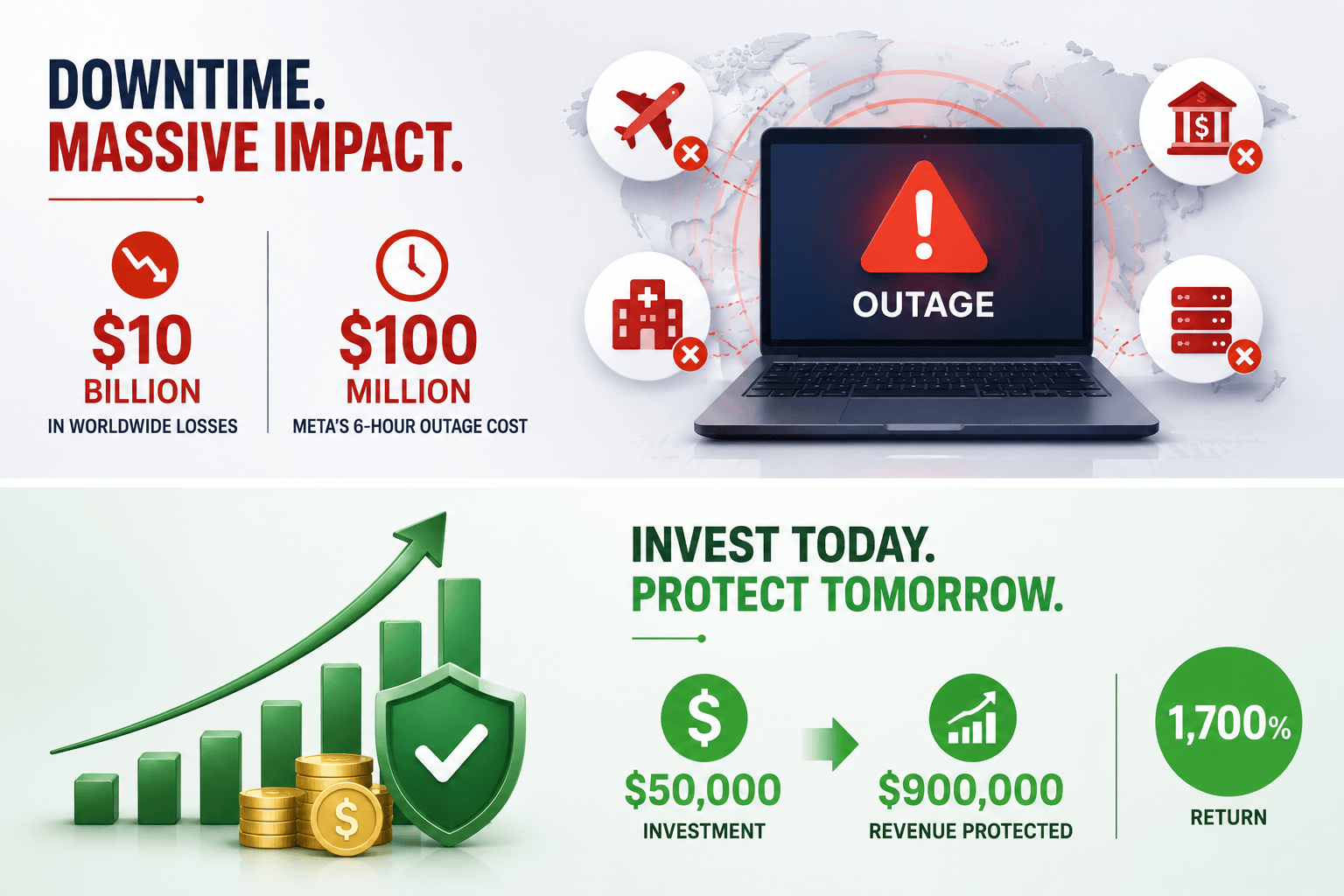
The July 2024 CrowdStrike incident—caused by a single faulty software update—resulted in $10 billion in worldwide losses and grounded flights, disrupted hospitals, and paralyzed financial systems globally. Meta’s 2024 six-hour outage cost an estimated $100 million. These are extreme cases, but they illustrate a principle that applies at every scale: digital infrastructure needs active management, not passive assumption.
The good news: business continuity investments return dramatically positive ROI. Documented cases show organizations investing $50,000 in proactive disaster recovery protecting $900,000 in revenue—a 1,700% return (Acronis).
Common Misconceptions About Website Maintenance
Before introducing a structured approach to website maintenance strategy, it’s worth clearing the air on a few persistent myths:
Misconception 1: “We built it once, so we’re done.”
This is the most common and costly mistake. A website without ongoing maintenance is a security liability and a performance liability from the moment the development team walks away. Platforms update, browsers evolve, and attackers never stop looking for entry points.
Misconception 2: “Website maintenance is just updating plugins.”
Plugin updates are one component. Comprehensive website maintenance includes performance monitoring, backup testing, SEO audits, content freshness, security scanning, SSL renewal, and UX evaluation. Treating it as a single checkbox task leaves significant gaps.
Misconception 3: “Our site is too small to be hacked.”
Attackers rarely target small sites manually. Automated bots scan millions of URLs simultaneously for known vulnerabilities. Site size is irrelevant. Unpatched software is the entry point.
Misconception 4: “We can fix it when something breaks.”
This is the reactive trap. As the data shows, reactive maintenance costs exponentially more than preventive maintenance—in both financial and reputational terms. A hacked site, a Google blacklist, or a failed backup during a crisis are all avoidable with the right strategy in place.
Misconception 5: “Maintenance slows down our roadmap.”
The opposite is true. A well-maintained website is faster to update, easier to scale, and more stable as a foundation for new features. Technical debt from neglected maintenance is what genuinely slows teams down.
Introducing the Codewitty Website Maintenance Framework
Codewitty’s approach to website maintenance services is built on a proprietary five-pillar framework, designed to give businesses a structured, repeatable system for keeping their digital presence healthy and competitive. This is not a one-size-fits-all checklist—it is a strategic architecture adaptable to startups, SMEs, and enterprise clients across industries including retail, e-commerce, fintech, edtech, logistics, and hospitality.
At a high level, the Codewitty Website Maintenance Framework™ is organized around five interconnected pillars:
- Protect — Security monitoring, malware scanning, SSL certificate management, Web Application Firewall configuration, and blacklist monitoring. The goal is zero unplanned security incidents.
- Perform — Speed optimization, Core Web Vitals management, uptime monitoring, and hosting infrastructure review. The goal is consistent, measurable performance above conversion-critical thresholds.
- Publish — CMS and plugin updates, content updates, page creation, blog management, and SEO hygiene. The goal is a website that stays fresh, relevant, and visible in search.
- Preserve — Automated daily backups, tested restore protocols, and disaster recovery planning. The goal is business continuity regardless of what goes wrong.
- Progress — Analytics review, UI/UX improvements, monthly reporting, and strategic recommendations. The goal is continuous improvement, not just maintenance of the status quo.
Each pillar operates on a defined cadence—daily, weekly, monthly, and quarterly tasks—ensuring nothing falls through the gaps. Part 2 of this guide will break down each pillar in granular detail, including the specific tasks, tools, and benchmarks Codewitty uses with clients.
Key Website Maintenance Statistics at a Glance
For business leaders who want a rapid-reference snapshot before getting into the weeds, these figures tell the story clearly:
Metric | Data | Source |
Mobile users who abandon slow sites | 53% leave if load time exceeds 3 seconds | Google, 2024 |
Conversion impact of 1-second delay | 7% reduction in conversions | Akamai |
Websites hacked daily (globally) | 30,000 | Sophos |
Hacked sites running outdated software | 83% | Sucuri |
Cyberattacks targeting small businesses | 43% | Verizon DBIR, 2025 |
Average hacked site recovery cost | $3,000–$25,000 | IT-Premium, 2026 |
Users unlikely to return after bad UX | 88% | Usability Geek |
Users who scroll past page 1 of Google | 25% (75% never do) | Moz |
Annual downtime cost (Global 2000) | $400 billion | Splunk, 2024 |
Downtime preventable with better processes | 80% | Uptime Institute, 2025 |
Frequently Asked Questions About Website Maintenance Services
Website maintenance is the ongoing process of keeping a website secure, fast, functional, and up to date. It includes software and plugin updates, security monitoring, malware scanning, performance optimization, content updates, backup management, SEO hygiene, broken link fixing, and uptime monitoring. The specific tasks vary based on the website's size, platform, and business goals.
Most websites require a combination of daily, weekly, monthly, and quarterly maintenance tasks. Daily tasks include automated uptime monitoring and malware scans. Weekly tasks include CMS updates and error log review. Monthly tasks include Core Web Vitals analysis, SSL checks, and performance reporting. Quarterly tasks include full SEO and security audits, cross-device testing, and strategic reviews.
Search engines prioritize websites that load quickly, are secure (HTTPS), have no broken links, and publish fresh, relevant content. Neglecting maintenance leads to slower load speeds, crawl errors, outdated metadata, and ranking penalties. Core Web Vitals have been an official Google ranking factor since 2021, meaning technical health directly impacts search visibility.
Website maintenance is a proactive, ongoing service covering regular updates, security, performance optimization, and content management. Website support typically refers to reactive technical assistance—fixing specific issues as they arise. The most effective approach combines both: proactive maintenance to prevent problems, and responsive support when unplanned issues occur.
Warning signs include slow page load times, browser security warnings, broken links or 404 errors, declining organic traffic, outdated content, plugin conflicts, failed form submissions, and any drop in conversion rates. A free website audit from a qualified website maintenance company will surface issues you may not be aware of.
Directly and significantly. The majority of successful cyberattacks exploit known vulnerabilities in outdated CMS platforms, themes, and plugins. Regular software updates, SSL management, Web Application Firewall configuration, and malware scanning—all core components of professional website maintenance services—eliminate the vast majority of these attack vectors. According to Sucuri, 83% of compromised sites were running software with available patches at the time of the breach.
A website maintenance strategy is a documented, proactive plan defining what will be maintained, how frequently, by whom, and according to what performance benchmarks. Without a strategy, maintenance becomes ad hoc and reactive—expensive, inconsistent, and inadequate. A defined strategy ensures that security, performance, SEO, and content are all managed on a predictable cadence, reducing risk and protecting the business's digital investment.
Every business with an active website needs some level of maintenance. The scope and frequency will differ: a high-traffic e-commerce store needs daily monitoring and frequent performance optimization, while a smaller corporate site might operate effectively on a monthly maintenance plan. Codewitty serves startups, SMEs, and enterprise clients across industries including retail, fintech, edtech, logistics, hospitality, and media.
Look for a company with demonstrated experience on your specific platform (WordPress, Shopify, Magento, etc.), transparent and customizable pricing, clear SLAs for response times, proactive monitoring capabilities, and regular reporting. Avoid vendors who offer only reactive support with no preventive framework. Codewitty's free website audit is a practical first step—it surfaces specific issues without obligation and gives you a clear picture of your site's current health.
Ready to Protect Your Website? Explore Codewitty's Website Maintenance Services
A website without a maintenance strategy is a liability waiting to surface. Whether you’re running a lean startup, managing a growing SME, or overseeing digital infrastructure for an enterprise, Codewitty’s website maintenance services provide the structure, expertise, and responsiveness your online presence requires.
Codewitty’s flexible website maintenance packages cover everything from security and performance to content management and technical support—available on monthly, hourly, or on-demand terms. No hidden fees. No rigid long-term contracts. Just proactive, expert website management built around your specific needs.
Start with a free website audit. In a single review, Codewitty’s team will identify your site’s current vulnerabilities, performance gaps, and maintenance priorities—so you know exactly what needs attention and why.